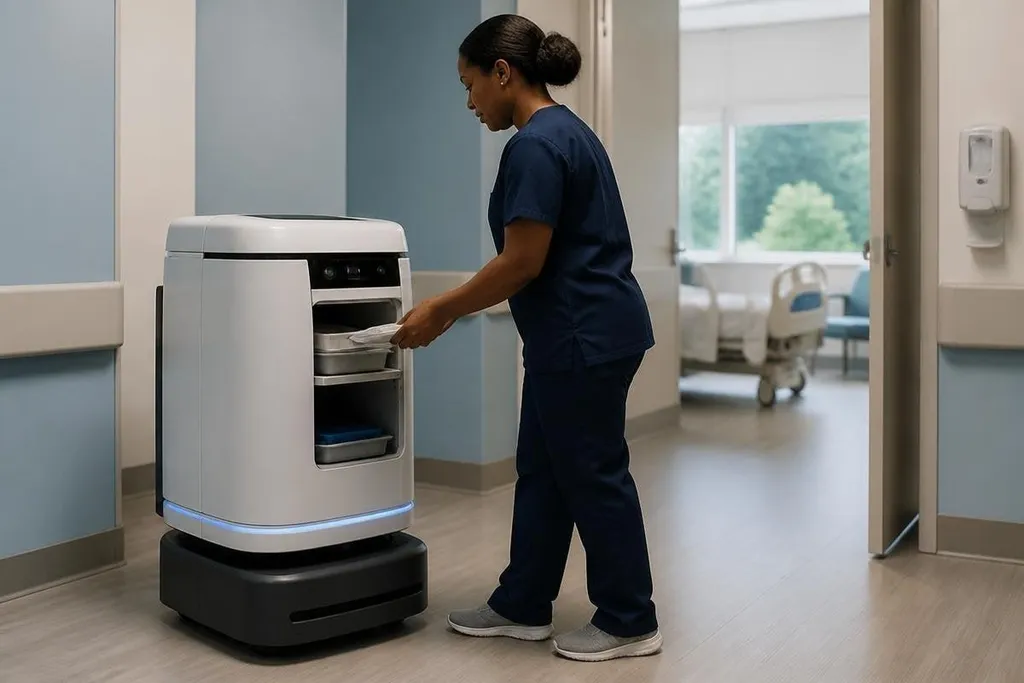
A healthcare robot may carry medicine, move supplies, clean a room, guide a surgical tool, or help a patient walk. Each job brings a different benefit, and each adds a different way for people, software, and hardware to fail.
For hospital leaders comparing automation, the useful question is narrow: which task should a robot do, under what supervision, and what happens when it stops?
- Robots can take on repeated transport, cleaning, and lifting tasks.
- Human staff still need to check patient contact, exceptions, and failures.
- The main risk often sits in the handoff between robot and care team.
Where healthcare robots help
Hospitals contain many repeated movements. Staff may move linens, meals, samples, waste, and medicine between rooms and departments. A mobile robot can follow a mapped route, stop for people, and send a status update when it reaches its destination.
That can reduce walking for staff and keep some supplies moving during busy periods. The gain depends on the building, floor plan, lifts, doors, and rules for shared spaces. The same system may need new maps and safety checks in another ward.
Robotic surgical systems support a surgeon’s hand movements through powered instruments and a camera. The surgeon remains responsible for the procedure, while the system can offer controlled instrument movement and a magnified view. The robot does not decide what treatment a patient needs.
Other systems focus on physical care. A rehabilitation robot or powered exoskeleton can repeat guided movements during therapy. That may give a patient more practice, but a therapist still needs to set the task and watch for pain, fatigue, or unsafe movement.
The risks sit close to people
Hospitals are harder for mobile robots than warehouses. Patients may stop in a corridor, beds can block routes, and staff may move quickly through doors. When a robot detects an obstacle, it still needs a safe response if the obstacle is a child, a person who has fallen, or a bed being pushed around a corner.
Patient data creates another risk. A robot with cameras, microphones, location data, or access to medical records can collect information beyond the task it was given. The hospital needs clear rules for storage, access, deletion, and software updates before the robot enters a patient area.
Physical contact needs its own review. A delivery robot can damage a cart or catch a cable.
A lifting system can place force on a patient’s body. A surgical robot can affect tissue through an instrument controlled by software and a clinician. These systems need different tests, limits, alarms, and emergency stops.
A failure also changes staff work. If a robot stops outside a lift, someone must move the item by hand. If a software update changes its route, someone must check the new behavior. Automation can remove one task and add several checks around it.
A hospital cannot judge a delivery robot by its route alone. It also needs to know who takes over after a stop and what staff do next. Reporting from Robot 24 can add named machines and stated limits before the hospital checks the robot’s effect on daily care.
What hospitals should check first
A safe rollout starts with a small task and a clear owner. The hospital should record how the work happens now, where people make decisions, and what the robot will do when a sensor, network link, battery, or motor fails.
Use this checklist before buying or testing a system:
- Name the task: Write the exact job, route, load, and hours of use.
- Set human control: Choose who can pause the robot, move the item, and report a fault.
- Check the setting: Test doors, lifts, corridors, floor surfaces, lighting, and patient traffic.
- Protect patient data: Limit cameras, microphones, records, storage, and staff access.
- Plan failure work: Keep a manual process for low battery, blocked routes, network loss, and software faults.
- Measure the result: Compare time, errors, staff effort, and patient complaints before and after the trial.
What remains unproven
A demonstration in an empty corridor says little about a hospital at shift change. Buyers need evidence from the same type of ward, with the same doors, lifts, traffic, staff rules, and patient needs.
The hardest part is often not movement. It is deciding when a robot should stop, who should respond, and how quickly the care team can recover the task. I’d choose a system that handles one narrow job well over a wider system that leaves those answers unclear.
Healthcare robots make the most sense when they remove repeated physical work without hiding responsibility. The next useful test is simple: run the robot beside the real care team, record every stop and handoff, and keep the manual process until those numbers hold.